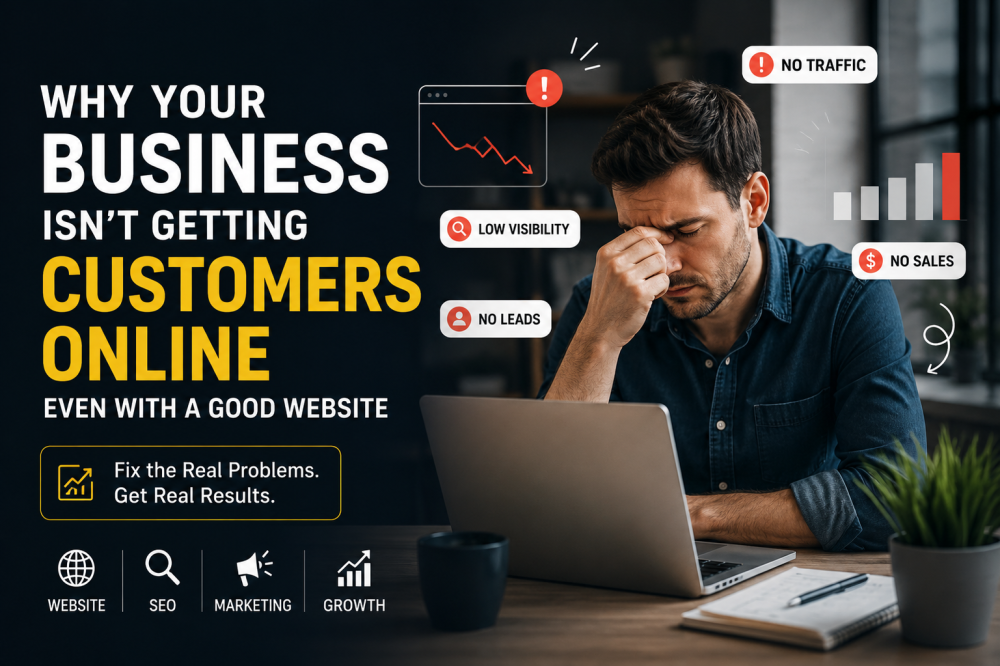
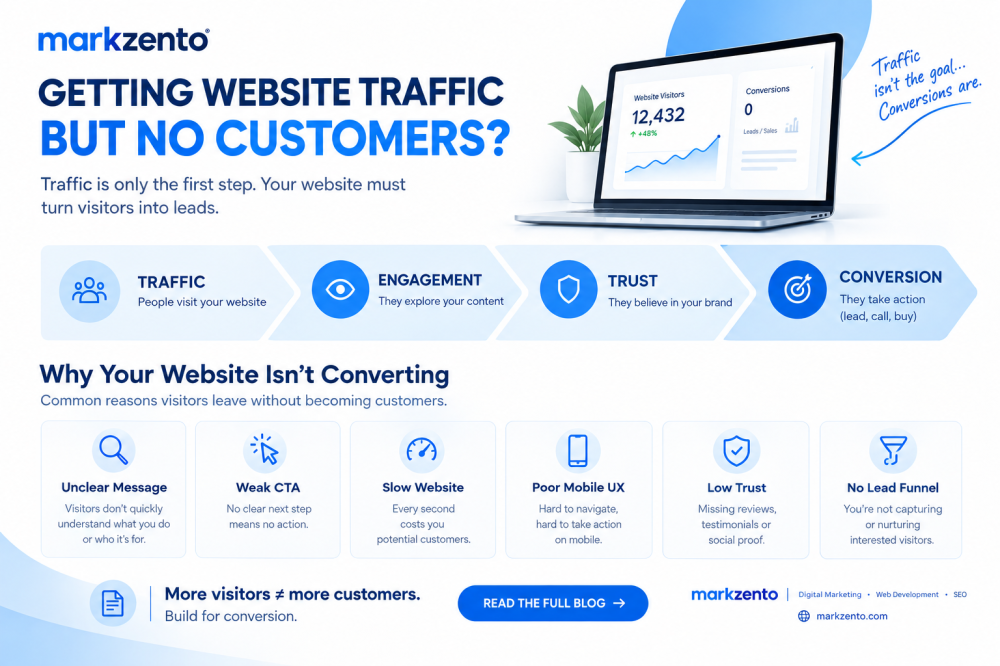
You paid for the design. It looks sharp. The pages load. Everything works the way it's supposed to work.
And yet — no inquiries. No leads. No sales.
If that sounds familiar, you're not alone. This is one of the most common frustrations we hear from business owners. They've invested in a website, sometimes a significant investment, and the results simply aren't there. The phone isn't ringing. The contact form isn't filling up. The traffic numbers, if they're looking at them at all, are embarrassingly low.
Here's what most people get wrong about this problem: they assume a good website is supposed to generate customers on its own. It isn't. A website is a tool, not a strategy. Think of it like a storefront. A beautiful store in a location where nobody walks by is still a failing store. The design matters, but it's only one piece of a much larger system.
The reasons your website isn't bringing in customers usually fall into two categories: people can't find you, or people find you but don't take action. Most struggling sites have problems in both.
Let's walk through what's actually happening — and what you can do about it.
What it is: When someone searches for what you offer, your website doesn't appear — or it appears on page four where nobody looks.
Why it hurts: This is the most fundamental failure. If people can't find you, nothing else matters. Studies consistently show that the overwhelming majority of clicks go to the first few organic results. If you're not there, you're invisible to the people actively looking for what you sell.
How to identify it: Search for your primary service plus your city. For example, if you're a plumber in Austin, search "plumber Austin." Do you appear on the first page? If not, you have a visibility problem. You can also use free tools like Google Search Console to see what queries your site is actually appearing for — and whether impressions are turning into clicks.
What to do about it: Visibility in traditional search requires three things working together: technical health (Google can crawl and index your pages), content relevance (your pages clearly match what people search for), and authority signals (other reputable sites link to you). For local businesses, a fully optimized Google Business Profile is non-negotiable — it's often the single highest-impact thing you can do. For broader reach, you need a content and SEO strategy that targets the specific phrases your customers actually type into Google.
The landscape here is also shifting. AI-powered search results, including Google's AI Overviews, now answer many queries directly on the results page. A study from Agarwal et al. (2026) found that organic clicks dropped by roughly 40% when an AI Overview appeared . That doesn't mean SEO is dead — it means the game has changed. You now need to be not just a ranked link, but a cited source. That requires a different approach to content structure and authority building.
What it is: Tools like ChatGPT, Perplexity, and Google's AI Mode now answer questions directly. If your business isn't mentioned in those answers, you're missing a growing source of high-intent discovery.
Why it hurts: AI search referrals are still smaller in volume than traditional search, but they convert at significantly higher rates. According to Semrush data cited in industry analysis, AI search visitors are roughly 4.4 times as valuable as the average traditional organic visitor, and AI referral traffic is about three times as likely to convert . That's because someone arriving from an AI answer has often already done their research and is closer to a decision.
How to identify it: Ask ChatGPT or Perplexity about your business category. For example, if you run an accounting firm, ask "What's the best accounting firm for small businesses in [your city]?" If your competitors show up and you don't, you have an AI visibility gap.
What to do about it: AI engines pull from across the web — your own content, review platforms, industry directories, social discussions, press mentions. The work involves making your content extractable and citable (clear answers, structured formatting), building consistent brand descriptions across the web, earning mentions on platforms AI trusts, and claiming your profiles on review sites like Clutch, G2, and Trustpilot . This is sometimes called generative engine optimization, or GEO. It's not a replacement for traditional SEO — it's an extension of it.
What it is: If you serve a geographic area — a city, a region, a neighborhood — and your website isn't optimized to appear in local searches and map results, you're losing customers to competitors who are.
Why it hurts: Local searches are among the highest-intent queries out there. Someone searching "dentist near me" or "emergency electrician [city]" needs help now. If your Google Business Profile is incomplete, your NAP (name, address, phone) information is inconsistent across directories, or your site lacks location-specific content, you're essentially absent from the map.
How to identify it: Search for your service plus your city. Look at the map pack — the three local results Google shows before organic listings. Is your business there? If not, check your Google Business Profile. Is it claimed? Complete? Are there photos, hours, services listed? Are there reviews?
What to do about it: Claim and fully optimize your Google Business Profile. Ensure your business information is consistent across every directory, citation, and social profile. Build location-specific pages on your website if you serve multiple areas. Actively request reviews from satisfied customers — review count and sentiment are major ranking factors for local visibility.
What it is: When someone lands on your homepage, they can't quickly tell what you do, who you do it for, and why they should care.
Why it hurts: You have seconds — often less — to communicate value. If a visitor has to work to understand whether you're relevant to them, they leave. Generic phrases like "solutions for businesses" or "committed to excellence" don't communicate anything. They create no reason to stay.
How to identify it: Show your homepage to someone unfamiliar with your business. Ask them to tell you what you offer and who it's for. If they hesitate or give a vague answer, your messaging needs work.
What to do about it: Lead with clarity. State what you do, who you help, and what outcome you deliver. Specificity builds trust. "We help dental practices in suburban Chicago fill their appointment books with local patients" is infinitely more compelling than "We provide marketing solutions." Your headline should speak directly to your ideal customer's situation.
What it is: Your site is slow, confusing to navigate, cluttered, or difficult to use on a phone.
Why it hurts: User experience directly affects whether visitors stay or leave. Google's own research and industry benchmarks have consistently shown that even small delays in load time dramatically increase bounce rates. Poor mobile experience is even more damaging, since the majority of local searches happen on phones. If your site frustrates people, they'll leave — and they'll go to a competitor who doesn't.
How to identify it: Test your site on a phone. Is text readable without pinching? Are buttons easy to tap? Does it load in under three seconds? Run it through Google's PageSpeed Insights tool. Then watch a stranger try to use it. Where do they hesitate? Where do they get stuck?
What to do about it: Prioritize speed, mobile responsiveness, and simplicity. Every page should have one clear purpose. Navigation should be intuitive. The path from landing to taking action should be obvious and friction-free. If your site is built on an outdated platform or has years of accumulated clutter, a focused rebuild may be more effective than patching problems.
What it is: A visitor is interested, but they don't know what to do next. There's no obvious call-to-action, or there are so many competing buttons that they don't know where to click.
Why it hurts: Interest without direction is wasted. You've done the hard work of getting someone to your site and getting them engaged. Don't lose them because they're unsure how to take the next step.
How to identify it: Look at your homepage and key service pages. Is there a single, clear action you want visitors to take? Is it visible without scrolling? Does it use specific, action-oriented language?
What to do about it: Every page should have a primary call-to-action. Not five. One. "Get a Free Quote," "Schedule a Consultation," "Book Your Appointment." Make it visually prominent and repeat it at logical points throughout the page. Remove or de-emphasize competing CTAs that distract from the primary action you want.
What it is: Visitors don't have enough evidence that you're credible and reliable.
Why it hurts: Every visitor is asking themselves: "Can I trust these people with my money, my time, my problem?" Without visible trust signals — reviews, testimonials, case studies, credentials, clear contact information — you're asking them to take a risk based on nothing but your own claims about yourself.
How to identify it: Put yourself in a first-time visitor's position. Would you hire this business based on what's on the site? Is there evidence of real work done for real clients? Are there reviews you can read? Is there a human face or a real address?
What to do about it: Make trust visible. Add testimonials with names and details. Publish case studies that show real outcomes. Display relevant certifications, awards, or affiliations. Include a phone number and physical address. A well-written About page that introduces the real people behind the business builds more confidence than you might expect.
What it is: You're attracting the wrong visitors — or creating content that doesn't align with what your ideal customers actually search for.
Why it hurts: Traffic that doesn't convert is worse than no traffic. It inflates your numbers while producing nothing. This often happens when businesses create content around topics they find interesting rather than topics their customers are actually searching for.
How to identify it: Look at the queries driving traffic to your site in Google Search Console. Do they match the problems your services solve? If you're getting visits for informational queries that have nothing to do with your paid offerings, you're attracting the wrong audience.
What to do about it: Start with customer questions. What do people ask you on the phone? What concerns come up in sales conversations? What problems are they trying to solve? Create content that directly addresses those. Match your content to search intent — if someone searches "how to fix a leaky faucet," they may not be ready to hire a plumber yet, but they might be if your content demonstrates expertise and offers help when they're ready.
What it is: Someone submits a form or calls, and the follow-up is slow, inconsistent, or nonexistent.
Why it hurts: Lead response time is one of the most underappreciated factors in conversion. Research has consistently shown that responding within minutes rather than hours dramatically increases the odds of qualifying a lead. If you're letting inquiries sit for a day or more, you're losing business to faster competitors.
How to identify it: Test your own process. Submit a form on your website. How long until you get a response? Is it personal? Does it move the conversation forward? If you're not confident in the answer, neither are your prospects.
What to do about it: Set up a system that ensures every inquiry gets a prompt response. Even an automated acknowledgment with a clear next step is better than silence. If you can't respond within minutes, consider tools that automate initial outreach while maintaining a personal touch. The businesses that win are often the ones that simply respond faster.
What it is: You're looking at traffic numbers or social media likes instead of the metrics that actually indicate business health.
Why it hurts: You can't improve what you don't measure accurately. If you're focused on vanity metrics — raw visits, impressions, follower counts — you might miss the real problem: that your site is attracting visitors who will never become customers. Or you might miss the opposite: that you're getting fewer visits but more qualified leads.
How to identify it: What does your analytics actually tell you? Can you trace an inquiry or sale back to its source? Do you know which pages are producing leads and which are just producing traffic?
What to do about it: Focus on the metrics that map to business outcomes: conversion rate, cost per lead, lead quality, and the specific pages and channels that drive inquiries. Set up proper conversion tracking in Google Analytics or your analytics platform of choice. Know which keywords, pages, and campaigns actually produce customers — not just visitors.
Here's what all of this comes down to: a website alone doesn't generate customers. A website is the center of a system. That system includes:
Search visibility — being findable when people search, both in traditional search and AI answers
Content — creating material that matches what your customers are actually looking for
Trust signals — reviews, credentials, testimonials, and proof that you deliver
Conversion optimization — making it easy and obvious for interested visitors to take the next step
Follow-up systems — responding quickly and effectively when someone reaches out
Analytics — measuring what actually matters and improving based on data
When one piece is weak, the whole system underperforms. The most common mistake is investing in one piece — usually the website itself — and expecting it to compensate for everything else.
Run through this. Be honest with yourself.
Visibility: Do you appear on the first page for your main service + your location? Are you cited in AI answers for relevant questions?
Local presence: Is your Google Business Profile complete and active? Do you have recent reviews?
Messaging: Can a stranger tell what you do and who you serve within five seconds on your homepage?
User experience: Does your site load quickly on mobile? Is navigation intuitive?
Conversion: Does every key page have one clear call-to-action?
Trust: Are there testimonials, case studies, or reviews visible on the site?
Follow-up: How quickly do you respond to an inquiry? Is the process consistent?
Measurement: Do you know which pages and channels actually produce leads?
If you found yourself hesitating on more than two or three of these, you've identified areas worth addressing.
The good news is that none of these problems are permanent. They're solvable. But solving them requires looking at your digital presence as an integrated system rather than a collection of disconnected pieces.
Start with the fundamentals. Fix visibility before you optimize conversion — there's no point making a site convert better if nobody's finding it. Fix conversion before you scale traffic — otherwise you're just sending more people to a site that doesn't work. Build follow-up into your process before you spend money on ads.
And be realistic about what you can do yourself versus what benefits from outside expertise. Many business owners can improve their Google Business Profile, clarify their messaging, and set up basic conversion tracking. More technical work — search optimization, AI visibility, conversion rate optimization, content strategy at scale — often benefits from working with specialists who do this every day.
If you've read this and recognized your own business in more than a few of these points, that's not a failure. It's a diagnosis. And a diagnosis is the first step toward fixing the problem.
If your site looks professional but you're not getting inquiries, the problem is likely visibility (people can't find you), conversion (people find you but don't take action), or both. Check whether you appear in search results for your key services, whether your messaging is clear, and whether there's an obvious next step for visitors.
SEO timelines vary based on competition, your starting point, and the scope of work. Some improvements — like optimizing your Google Business Profile — can produce results within weeks. Content and authority-building efforts typically take several months to gain meaningful traction. Anyone promising guaranteed rankings or overnight results is not being honest with you.
Traditional SEO focuses on ranking in search engine results pages. AI search optimization (sometimes called GEO or generative engine optimization) focuses on being cited or mentioned in AI-generated answers from tools like ChatGPT, Perplexity, and Google's AI Overviews. Both matter in 2026, but they require different tactics .
It depends entirely on your conversion rate and the value of your average customer. A site converting at 5% needs far less traffic than one converting at 0.5%. Rather than chasing traffic volume, focus on attracting qualified visitors and improving your conversion rate. Fifty highly qualified visitors can outperform five thousand unqualified ones.
Some fixes — clarifying messaging, improving your Google Business Profile, setting up basic analytics — are within reach for most business owners. More technical work like technical SEO, conversion optimization, content strategy, and AI visibility often benefits from professional help. A good agency will help you understand what you can do yourself and where their expertise adds the most value.
Fix visibility before conversion. There's no point optimizing a site that nobody finds. Then fix conversion before scaling traffic — otherwise you're just paying to send more people to a site that doesn't work. Build follow-up systems before you spend money on ads. Get the fundamentals right before adding complexity.
Track conversion-focused metrics: form submissions, phone calls, booked appointments, and sales. Set up conversion tracking in Google Analytics. Know which pages and channels produce inquiries, not just traffic. Raw visitor numbers matter far less than qualified leads.
Not sure where your website is falling short?
If you've read this and recognized your own business in more than a few of these points, the next step is a conversation. We'll take a look at your site, your visibility, and your current approach — and give you an honest assessment of what's working and what needs attention.
No pressure. No obligation. Just a clear-eyed look at where you stand and what it would take to start generating the customers you expected when you invested in your website.
[Contact us for a free website and digital presence assessment →]
We'll show you exactly what's holding your site back — and what to do about it.